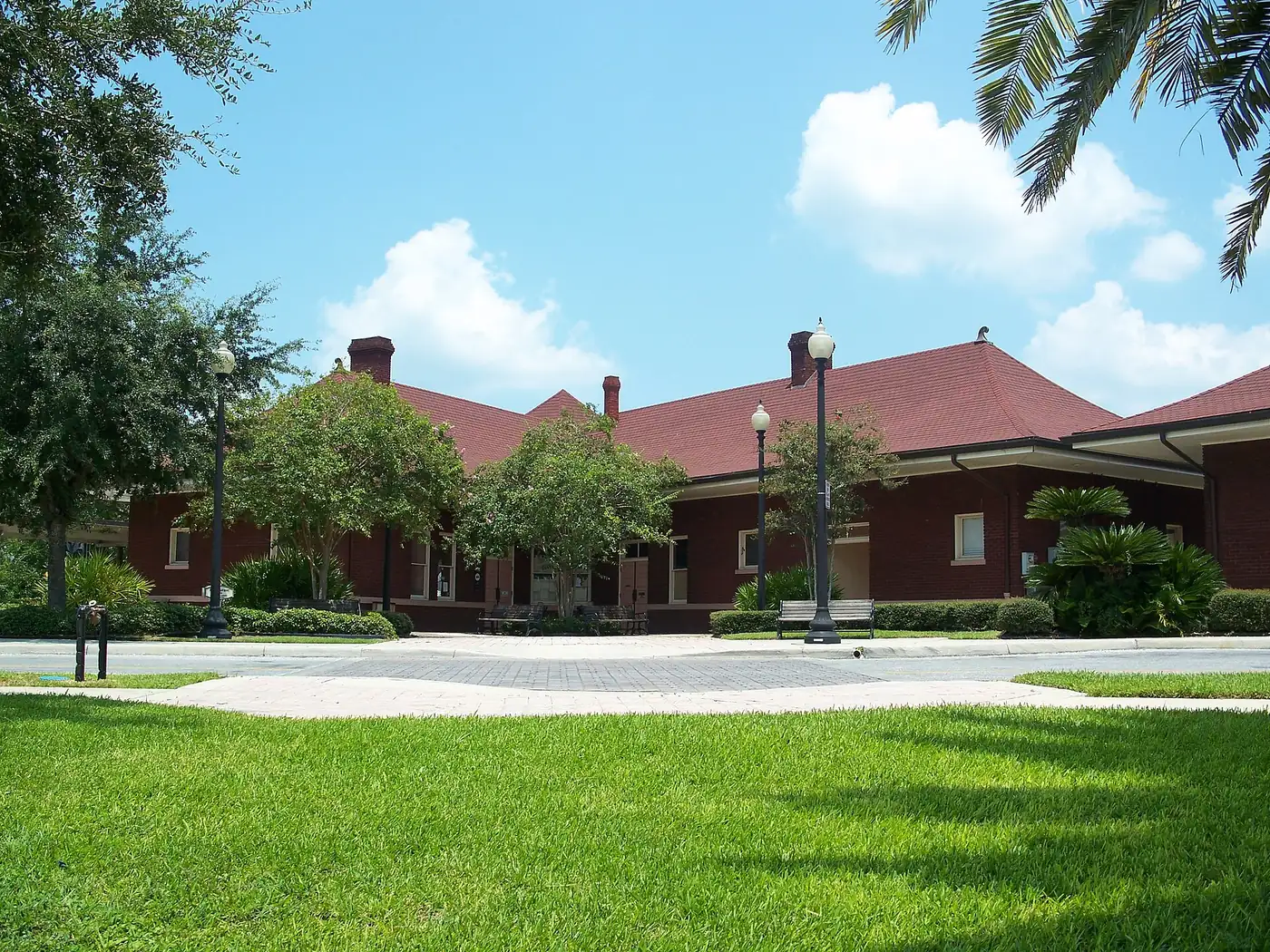
Ocala was platted in 1846 as the Marion County seat, rebuilt in brick after the 1883 fire and has 14 National Register listings with Ocala addresses.
Last checked Oct. 9, 2026. History comes from the City of Ocala’s downtown historic context page, West Ocala history page and Fort King history page; listings from the National Park Service’s National Register database; and markers from the Florida Division of Historical Resources’ historical marker program.
Ocala’s story starts at Fort King, a U.S. Army post at the edge of the Seminole lands, and runs through a riverboat and railroad trading town, the 1883 fire that made it the “Brick City” and the Black community of West Ocala, whose history the city has documented in its own preservation pages.
Who to call
- Fort King National Historic Landmark visitor center: 352-368-5533 (hours are limited; call ahead)
- City historic preservation and districts: Planning Division, 352-629-8404
- Historic Ocala Preservation Society, Bryant House: historicocala.org, tours by appointment
How Ocala began
- 1827: Fort King, named for Col. William King, is first occupied next to a Seminole Agency set up in 1825, the state’s Fort King marker says.
- Dec. 28, 1835: warriors led by Osceola kill Indian agent Wiley Thompson and four others outside the fort; the attack opened the Second Seminole War.
- March 25, 1844: the Legislative Council of the Territory of Florida creates Marion County, named for Revolutionary War hero Francis Marion, with Fort King as its seat.
- Feb. 26, 1846: the new county board selects Ocala as the county seat. In March, county engineer David Bruton draws the first plat of Ocala: 80 blocks around a public square set aside for a courthouse.
- Sept. 12, 1847: Ocala gets its own post office.
- 1851: the first permanent courthouse is finished on the public square.
- 1870: the first official census of Ocala counts 600 residents.
- 1876: the first railroad, from Waldo, reaches Ocala.
- Nov. 29, 1883: a Thanksgiving Day fire destroys most of downtown. Rebuilding in brick, granite and metal earns Ocala the name “the Brick City” within five years.
- December 1890: the National Farmers’ Alliance meets in Ocala and adopts the “Ocala Demands,” a platform of political and economic reforms.
Dates are from the city’s history pages and the state markers linked above.
West Ocala
The city’s West Ocala history records Howard Academy, Ocala’s first school for Black students, on land donated by James H. Howard; Mount Zion A.M.E. Church; and F.P. Gadsden, who opened the Ocala Bazaar in 1881 and in 1891 organized the Metropolitan Realty and Investment Company, described as the first Black-owned corporation chartered by the State of Florida. The West Ocala Historic District was added to the National Register in 2002.
National Register of Historic Places
The National Park Service register lists these properties and districts with an Ocala address, with the date each was listed. Some, such as the Old Fessenden Academy, are outside the city limits.
| Listing | Address | Listed |
|---|---|---|
| Coca-Cola Bottling Plant | 939 N. Magnolia Ave. | May 4, 1979 |
| Mount Zion A.M.E. Church | 623 S. Magnolia Ave. | Dec. 17, 1979 |
| Marion Hotel | 108 N. Magnolia Ave. | Oct. 16, 1980 |
| Ocala Historic District | Roughly Broadway, SE Eighth Street, Silver Springs Place, SE Third, 13th and Watula avenues | Jan. 12, 1984 |
| The Ritz Apartment | 1205 E. Silver Springs Blvd. | Aug. 21, 1986 |
| Tuscawilla Park Historic District | NE Fourth Street, Sanchez Avenue, Second Street, Tuscawilla Avenue and Watula Street | March 30, 1988 |
| E.C. Smith House | 507 NE Eighth Ave. | May 24, 1990 |
| Old Fessenden Academy Historic District | 4200 NW 90th St. | Sept. 29, 1994 |
| East Hall (Florida Industrial School for Girls) | 307 SE 26th Terrace | July 28, 1995 |
| Ocala Union Station | 531 NE First Ave. | Dec. 22, 1997 |
| Ocala Historic Commercial District | Roughly NW First Street, SE First Avenue, SW Second Street and SW First Avenue | June 3, 1999 |
| West Ocala Historic District | Roughly NW Fourth Street, W. Silver Springs Boulevard, NW 12th Avenue | June 27, 2002 |
| Fort King Site (also a National Historic Landmark) | Address restricted | Feb. 24, 2004 |
| Federal Building, U.S. Post Office and Court House | 207 NW Second St. | Sept. 6, 2022 |
Nearby, Silver Springs, 5656 E. Silver Springs Blvd., was listed Nov. 19, 2019.
The city designates two of its districts locally as well: the Ocala and Tuscawilla Park historic districts. See our building permits guide.
Museums and sites to visit
| Place | Address | Hours as published |
|---|---|---|
| Fort King National Historic Landmark | 3925 E. Fort King St. | Trail sunrise to 5 p.m.; visitor center hours limited, call 352-368-5533 |
| Appleton Museum of Art | 4333 E. Silver Springs Blvd. | 10 a.m. to 5 p.m. Tuesday to Saturday, noon to 5 p.m. Sunday, closed Monday |
| Marion County Museum of History and Archaeology | 307 SE 26th Terrace (East Hall) | Check with the museum |
| Black History Museum of Marion County | Howard Academy Community Center, 306 NW Seventh Ave. | 3 to 6 p.m. Wednesdays, free |
| Ocala Fire Museum | 615 NW Martin Luther King Jr. Ave. | 8 a.m. to 5 p.m. weekdays, free |
| Silver River Museum and Environmental Education Center | 1445 NE 58th Ave. | 10 a.m. to 4 p.m. Saturday and Sunday |
Hours for the Marion County museum, the Black History Museum, the Fire Museum and the Silver River Museum are as listed by the Ocala/Marion County visitors bureau; the Appleton’s are from its own site.
State historical markers in Ocala
- Fort King (1961), SE 39th Avenue
- Ocala Demands (1962), City Park Square, SE First Avenue
- The Old Courthouse Square (1997), the block bounded by Silver Springs Boulevard, SE First Avenue, SE First Street and S. Magnolia Avenue. Three courthouses stood here, built in 1851, 1884 and 1906; the last was torn down in 1965.
- American National Thrift Association (2018), SW Broadway and Pine Street, on Dr. Richard Samuel Hughes II’s hospital for Black patients, opened by 1925
- Florida Industrial School for Girls (2023), 307 SE 26th Terrace
What this means for you
- Start at Fort King: the replica fort and trail are open to explore.
- Walk the downtown square and the Ocala Historic District; the city’s historic districts map shows the boundaries.
- HOPS runs walking ghost tours of the historic district on October Saturdays.
Related: things to do this month, parks and trails and population.
Frequently asked questions
When was Ocala founded?
Marion County was created March 25, 1844, with Fort King as its seat. The county board chose Ocala as the county seat in February 1846, and the first plat of the town was drawn in March 1846, the City of Ocala’s history pages say.
Why is Ocala called the Brick City?
A fire on Thanksgiving Day, Nov. 29, 1883, destroyed most of downtown. The city rebuilt in brick, granite and metal, and within five years Ocala was known across Florida as the Brick City, the city’s history says.
What is Fort King in Ocala?
A U.S. Army frontier post first occupied in 1827, where the Second Seminole War began in December 1835. The site is a National Historic Landmark, designated Feb. 24, 2004, with a full-size replica fort at 3925 E. Fort King St.
How many National Register of Historic Places listings are in Ocala?
The National Park Service register lists 14 properties and districts with an Ocala address, from the Coca-Cola Bottling Plant and Mount Zion A.M.E. Church in 1979 to the federal building and courthouse in 2022.
Have your say