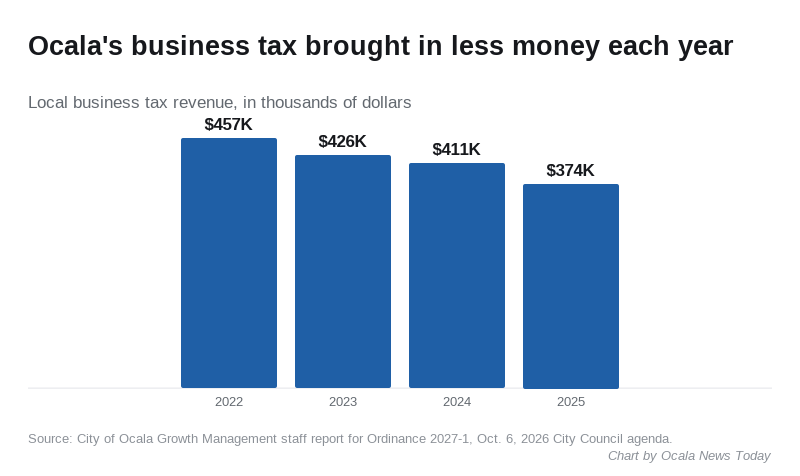
Ocala's council repealed the business tax receipt 5-0 on Oct. 20, with refunds by Jan. 14. Revenue fell to $374,000 in 2025 and the fee schedule dated from 1995.
Ocala businesses would no longer have to buy a city business tax receipt each year under an ordinance the City Council will vote on Tuesday, Oct. 20.
Updated Oct. 25: the council adopted Ordinance 2027-1 by a 5-0 vote on Oct. 20, according to its meeting synopsis. The city said Oct. 23 that businesses no longer need a receipt and that refunds will start by Jan. 14, 2027. Read our story on the repeal and refunds. The story below was published before the vote.
Council member Kristen Dreyer introduced Ordinance 2027-1 at Tuesday’s meeting. It repeals the city’s local business tax in full, for every business, profession and occupation inside the city limits. The second and final reading is set for Oct. 20, according to the council’s Oct. 6 meeting synopsis.
City staff also asked for approval to refund businesses that have already paid for the 2026-27 year. That request is in the Growth Management Department’s staff report on the ordinance, which recommends approval.
Why the city wants to drop it
The tax has been bringing in less money every year, according to the staff report. The cost of running it has gone up.
| Year | Revenue | Staff cost to run it |
|---|---|---|
| 2022 | $457,000 | $64,000 |
| 2023 | $426,000 | $61,000 |
| 2024 | $411,000 | $68,000 |
| 2025 | $374,000 | $69,000 |
The staff cost counts salaries only. With facilities, software, legal work and administration included, the report puts the city’s full cost “likely higher than $100,000 annually.” It adds that the city does not currently enforce the tax. Doing so would take more staff.
Staff gave several other reasons in the report:
- The fee schedule dates from 1995. It was set by Ordinance No. 2553 that September and has not been comprehensively updated since. Many of today’s businesses do not fit its categories.
- State law makes it hard to fix. Reclassifying businesses or changing rates requires an equity study commission under Section 205.0535 of the Florida Statutes, and increases are capped.
- Many businesses never got one. 4,462 businesses hold an active receipt. Staff estimate the number operating in the city is “possibly double or more” than that, based on utility accounts and the city’s own records.
- The Legislature may end it anyway. The Florida House passed HB 103 in the 2026 session by a vote of 82-26. The bill would have repealed the state law that allows the tax. It stalled in the Senate Appropriations Committee.
A simple majority of the council is enough to repeal the tax, the report said.
What it costs the city
The city’s adopted budget for the 2026-27 fiscal year counts on $426,000 from the tax. If the ordinance passes, the city’s Budget Office will cut that revenue line and reduce the general fund’s reserve for contingencies to match, according to the staff report.
The city is not the first in the region to drop the tax. A Growth Management summary attached to the ordinance lists:
- Leesburg, about 30 miles southeast, from Oct. 1, 2020
- Lake County, from the 2022 fiscal year
- Volusia County, from Jan. 1, 2024
- Sarasota County, from July 2024
- Clermont, from Jan. 28, 2025, which the summary says affected 2,000 businesses
What still applies
The ordinance says repeal does not exempt any business from building codes, zoning or fire inspections. Those stay in force through the Growth Management Department, the Building Division and Ocala Fire Rescue, according to the ordinance text.
The ordinance takes effect immediately once the mayor approves it, or once it becomes law without the mayor’s signature.
What it means for you
- If you run a business inside Ocala city limits, nothing changes until the Oct. 20 vote. If the council passes it, you would no longer need a city business tax receipt.
- If you already paid for 2026-27, staff have asked the council to approve refunds. The ordinance and staff report do not yet say how refunds would be claimed. We will update this story after the vote.
- Your other permits do not go away. Zoning approval, building permits, fire inspections and any state license from the Department of Business and Professional Regulation still apply. Alcohol sales still need the city’s location permit.
- You can speak at the meeting. The council meets at 4 p.m. Tuesday, Oct. 20, in the council chambers on the second floor of City Hall, 110 SE Watula Ave. Second readings of ordinances come under the agenda’s public hearings section.
- The ordinance, the staff report and the list of other jurisdictions are on the Oct. 6 agenda, with the other jurisdictions summary attached.
For more on starting a business here, see our page on new businesses in Ocala and our guide to building permits and zoning.
Have your say